
Useful Apps for Students in Higher Education

The disability services office at North Dakota State University (NDSU) has prepared lists of free and low-cost apps designed to support students in Higher Education.

The lists include apps to support the following

  • Note-taking
  • Study Supports
  • Organization
  • Reading and Writing
  • Captioning and apps for the Hard of Hearing
  • Vision
  • Focus
  • Math
  • Stress Management
  • Communication

Visit this link,  https://www.ndsu.edu/disabilityservices/assistive_technology/apps_to_support_students_in_higher_ed/. Once at this site, click on the app category in the left sidebar to explore the various app in the chosen category.
US Students With Disabilities Afforded Equality

Writing in VOA*, Char Freedberg, writes about the impact of the Americans with Disabilities Act (ADA) on higher education and the importance of reasonable accommodations.

To read the full article, visit “US Students With Disabilities Afforded Equality


A related article is “Americans With Disabilities Act Turns 30


Voice of America (VOA) is the largest U.S. international broadcaster, providing news and information in more than 40 languages to an estimated weekly audience of more than 280 million people. VOA produces content for digital, television, and radio platforms. It is easily accessed via your mobile phone and on social media. It is also distributed by satellite, cable, FM and MW, and is carried on a network of more than 2,500 affiliate stations.

Using Hearing Assistive Devices at Home

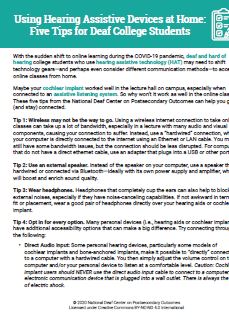
With the sudden shift to online learning during the COVID-19 pandemic, deaf and hard of hearing college students who use hearing assistive technology (HAT) may need to shift technology gears—and perhaps even consider different communication methods—to access online classes from home.

The tip sheet below from the National Deaf Center offers five tips for using hearing assistive  devices at home.


Tips for Deaf Students