Posts

Is This Location Accessible? Check it with AccessNow

At the Assistive Technology Blog, Venkat Rao writes about assistive technology, mostly about concepts/ devices that are still in prototype stages, but would be possibly mass marketed in the future. He also write about mobile apps/ software that make life easier for people with disabilities.
A recent post discusses AccessNow, an interactive map tool that tells users whether  locations they are wanting to visit are accessible or not, and if they are, how accessible are they (fully, partially, patio accessible, no accessibility).  As Rao notes:
 “A big hurdle for people in wheelchairs is that they need accessibility (ramps, automatic doors, alternative entrances) to enter buildings conveniently. They may be familiar with accessibility options at places they frequent but how about a new location they need to visit? A new restaurant or business establishment? An office location where they have a job interview? Are those locations accessible? If they can find out about accessibility options prior to reaching those locations, it can save them from going through the trouble and frustration of finding alternate entrances and workarounds to get accommodated.
Sign Language Interpreters: Hiring Qualified Interpreters

No discussion regarding hiring qualified interpreters is complete without an understanding of the definition of “qualified,” as it pertains to the  American with Disabilities Act (ADA), state regulation, and the concept of “effective communication.” Pepnet 2 has developed a resource designed just for this purpose.

The Fast Facts, Sign Language Interpreters: Hiring Qualified Interpreters,   discusses such topics as  minimum qualifications to be an interpreter; ; what interpreter certification is; the essential things you need to know in orderto hire the right interpreter.

Two other Fast Facts publications that are recommended to aid you in choosing the right interpreter are:

Fast Facts, Using Interpreters: In the Classroom and  Fast Facts, Sign Language Interpreters : Using Interpreters as a Reasonable Accommodation for Testing

Patient No More: the Section 504 Sit-In

On April 5, 1977, American people with and without disabilities showed the world the power of grassroots activism. In San Francisco, more than 100 people began a twenty-six day occupation of the Federal Building to insist on getting civil rights. Four years earlier, Section 504 of the Rehabilitation Act of 1973 made it illegal for any federally funded facilities or programs to discriminate against disabled people. One signature from the head of Health Education and Welfare (HEW) stood in the way of the law taking effect. People waited and waited. At last in 1977 frustration turned into bold action. A diverse coalition launched protests across the country. San Francisco’s occupation was the most significant. On April 30, 1977, San Francisco’s Section 504 occupiers emerged victorious from the longest take-over of a federal building in US history. A national disability rights movement was born.

San Francisco’s occupation of the HEW Building at 50 United Nations Plaza became the focal point of the protest. Enduring hardships, deprivations and medical risks, the occupiers dug in, finally emerging to join an April 30, 1977, victory rally after Secretary Califano signed the 504 regulations unchanged.

A virtual exhibit exploring this historical milestone in disability history is available at:

Patient No More Virtual Exhibit

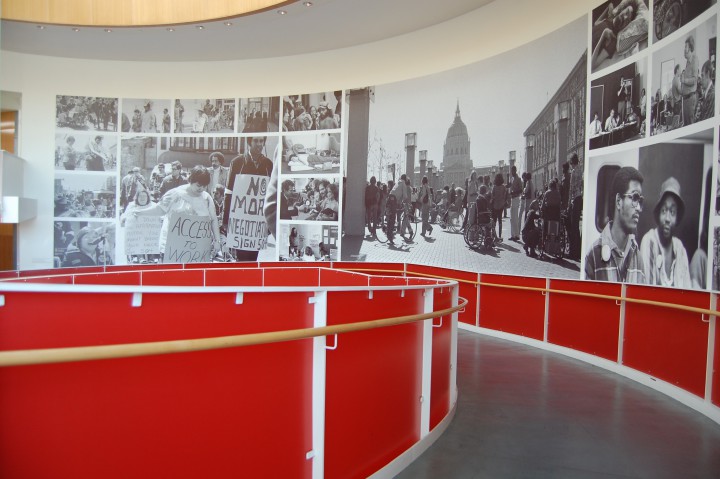
Mural: Patient No More Exhibit
Mural Excerpt: “Patient No More Exhibit.”  Photo by Fran Osborne