
Posts

8 Simple Ways Parents Can Teach Kids to Get Organized

Children and teens with ADHD and other learning difficulties typically have trouble with organization, time management, and transitioning to living independently. They need specific training on how to manage those skills, which are crucial for college and beyond.

But, to varying degrees, nearly all young people have trouble with these issues says Elizabeth C. Hamblet, a consultant and  learning specialist at Columbia University, where she helps students with time management, organization, reading, and study skills.

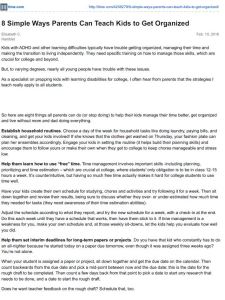
Hamlet recently authored a piece, 8 Simple Ways Parents Can Teach Kids to Get Organized, for Time Magazine, that offers eight tips all parents can do (or stop doing) to help their kids manage their time better, get organized and live without mom and dad doing everything.  This article and other helpful pieces can also be found at Hamblet’s site, Families and Students Preparation for College.

Readers may also click on the image below to access a PDF   copy of the article.
 

HAMBLET8SimpleWays

Is this a Service or an Emotional Support Animal

So you’ve received a request to permit an animal on campus. Now what? The answer is not always straightforward and it is always determined on a case-by-case basis.  But, the steps below can help guide your analysis.

Institutions may ask two questions about dogs identified as service animals.

  1. Is the dog required because of a disability?
  2. What work or task has the dog been trained to perform?

The student or staffers answers will guide how you proceed.

The critical  issue is one of task-training, NOT the nature of the disability.  What is the TASK the dog has been trained to perform?

  • If the dog has been trained to perform tasks related to the disability, then it’s a service dog, regardless of what type of disability it is.
  • Conversely, if the dog has not been task trained, then it is NOT a service dog regardless of  the type of disability the handler has.

Example: Just because a person is blind, deaf, or a wheelchair user, does not entitle that person to have access with an untrained pet dog just for emotional support. Conversely, because a person’s disability is psychiatric or balance related, does not entitle you to deny access for a dog who IS task-trained for that person’s disability.

Terminology used is meant to be descriptive of what the dog DOES for his/her handler: “Psychiatric service dog,” like “mobility dog,” “guide dog,” or “hearing dog,” is a term that merely identifies a particular type of service dog.   They are ALL service dogs. They are ALL covered by the ADA.

If the handler is a person with a disability, and if the dog is trained to perform assistance tasks related to the disability, then it is a service dog.