Posts

Navigating College: A Handbook on Self-Advocacy – Written for Autistic Students from Autistic Adults

The non-profit organization,  Autistic Self Advocacy Network (ASAN) seeks to advance the principles of the disability rights movement with regard to autism. As part of ASAN’s work to empower Autistic people across the world to take control of their lives  ASAN  has available in their resource library, a handbook for college students. Navigating College.

Written by autistic adults for college students with autism, this handbook contains five topical chapters: Accommodations, Housing, Health and Safety, Advocacy, and Social Issues.

Each chapter contains several essays covering some aspect of the topic.  There are 17 essays total. The introduction is written by Ari Ne’eman, president of ASAN.  The introduction, written by Jim Sinclair provides an overview of the ADA.

Samantha April Davis in a brief  two-paragraph piece preceding the essays reminds has this reminder for students.

You’re a college student now. Things are different from
what you are used to. A lot is being asked of you and it’s
not always easy meeting expectations. Nobody said it
was going to be easy. You might have a bit of trouble
along the way. You might struggle. A lot of people
struggle. You might have to ask for help. You might have
to ask even when you feel that you shouldn’t have to.
You’re in college now. Remember one thing: You made it
to college because you have potential. You are in college
because you demonstrated capability to get here. If you
are struggling now, it is because you are able and, while
your needs may be different or beyond that of the
typical college student, you are capable of meeting
those challenges given proper support.

This is a good reminder for all students.
Demystifying Post-Secondary Terms

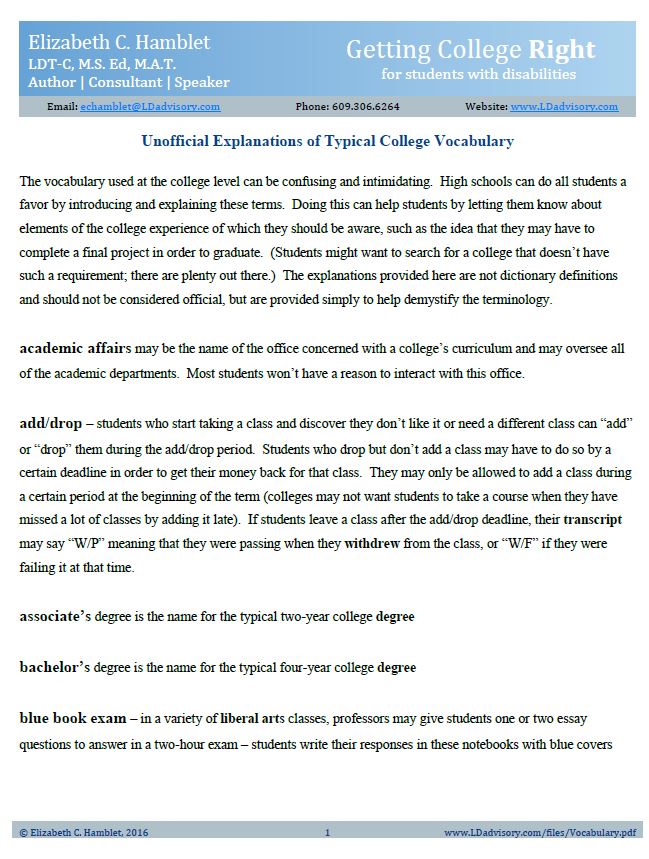
Elizabeth Hamblet,  Consultant and Learning Specialist at Columbia University, has developed an “unofficial” glossary of terms designed to define and explain words and phrases commonly used in the post-secondary environment.

The vocabulary used at the college level can be confusing and intimidating. High schools can do all students a favor by introducing and explaining these terms. . . .The explanations provided here are not dictionary definitions and should not be considered official, but are provided simply to help demystify the terminology.

Click on the image below to access a PDF of the glossary. It can also be found at: Unofficial Explanations of Typical College Vocabulary

Postsecondary Vocabulary list.


Take time to explore Elizabeth’s site as it contains many resources of value to students and parents. LDAdvisory.com

LD Resources Foundation Awards Assistive Devices to College Students in Need

Getting the right assistive technology at the post-secondary level can be difficult for students with learning disabilities.

It’s especially tough for adults applying to college with disability documentation (e.g. test scores) that no longer satisfy the school’s requirements for granting aid. Obtaining the  necessary tests can be time-consuming and costly.

The LD Resources Foundation can help students get the assistive technology they need, regardless of where they are in the evaluation process.

The nonprofit assists young adults with learning disabilities, including dyslexia and Attention Deficit Hyperactivity Disorder (ADHD), to access and succeed in higher education so they can reach their full potential. The Foundation currently offers five awards. Persons may apply for one or more awards using a single application.

To learn more, visit Apply for LDRF Awards.

About LD Resources Foundation

LD Resources Foundation helps students and adults diagnosed with dyslexia, ADHD, and other learning disabilities to access and succeed in post-secondary education programs and the workplace. Its services, which are limited to individual with financial need, include testing, mentoring, access to assistive technology, and an awards program.  Includes resources on assistive technology, organizational skills, scholarships and a Survival Guide for adults with LD or attention deficit disorder (ADD). The foundation’s headquarters are in New York City.For more information call 646-701-0000 or email info@ldrfa.org.