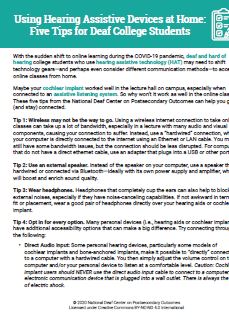
Using Hearing Assistive Devices at Home

With the sudden shift to online learning during the COVID-19 pandemic, deaf and hard of hearing college students who use hearing assistive technology (HAT) may need to shift technology gears—and perhaps even consider different communication methods—to access online classes from home.

The tip sheet below from the National Deaf Center offers five tips for using hearing assistive  devices at home.


Tips for Deaf Students

Mayo Clinic offers tips for managing test anxiety

Do you struggle with anxiety before exams? Have you ever wondered if it is  possible to overcome test anxiety?

A little nervousness before a test is normal and can help sharpen your mind and focus your attention. But with test anxiety, feelings of worry and self-doubt can interfere with your test-taking performance and make you miserable. Test anxiety can affect anyone, whether you’re a primary or secondary school student, a college student, or an employee who has to take tests for career advancement or certification.

Craig N. Sawchuk, Ph.D., L.P. from the Mayo Clinic offers several strategies that may  reduce test anxiety and increase your performance on test day.

  • Learn how to study efficiently. Your school may offer study-skills classes or other resources that can help you learn study techniques and test-taking strategies. You’ll feel more relaxed if you systematically study and practice the material that will be on a test.
  • Study early and in similar places. It’s much better to study a little bit over time than cramming your studying all at once. Also, spending your time studying in the same or similar places that you take your test can help you recall the information you need at test time.
  • Establish a consistent pretest routine. Learn what works for you, and follow the same steps each time you get ready to take a test. This will ease your stress level and help ensure that you’re well-prepared.
  • Talk to your instructor. Make sure you understand what’s going to be on each test and know how to prepare. In addition, let your instructor know that you feel anxious when you take tests. He or she may have suggestions to help you succeed.
  • Learn relaxation techniques. To help you stay calm and confident right before and during the test, perform relaxation techniques, such as deep breathing, relaxing your muscles one at a time, or closing your eyes and imagining a positive outcome.
  • Don’t forget to eat and drink. Your brain needs fuel to function. Eat the day of the test and drink plenty of water. Avoid sugary drinks such as soda pop, which can cause your blood sugar to peak and then drop, or caffeinated beverages such as energy drinks or coffee, which can increase anxiety.
  • Get some exercise. Regular aerobic exercise, and exercising on exam day, can release tension.
  • Get plenty of sleep. Sleep is directly related to academic performance. Preteens and teenagers especially need to get regular, solid sleep. But adults need a good night’s sleep, too, for optimal work performance.
  • Don’t ignore a learning disability. Test anxiety may improve by addressing an underlying condition that interferes with the ability to learn, focus or concentrate — for example, attention-deficit/hyperactivity disorder (ADHD) or dyslexia. In many cases, a student diagnosed with a learning disability is entitled to assistance with test taking, such as extra time to complete a test, testing in a less distracting room or having questions read aloud.
  • See a professional counselor, if necessary. Talk therapy (psychotherapy) with a psychologist or other mental health professional can help you work through feelings, thoughts and behaviors that cause or worsen anxiety.

What is Test Anxiety?

While it’s completely normal to feel a bit nervous before a test, some students find test anxiety debilitating. Racing thoughts, inability to concentrate, or feelings of dread can combine with physical symptoms like a fast heartbeat, headache, or nausea. Whether it’s the ACT , an AP exam , or an important history final, test anxiety has the power to derail weeks and months of hard work.

Test Anxiety Tips

According to the ADAA, causes of test anxiety may include a fear of failure, lack of adequate prep time, or bad experiences taking tests in the past. You’re not alone! Here’s what you can do to stay calm in the days leading up to and during your test.

1. Be prepared

Yes, this seems obvious, but it bears repeating. If you feel confident that you’ve prepped thoroughly, you’ll feel more confident walking into the test. Need help reviewing tough concepts or question types? The test prep experts at The Princeton Review can provide that extra boost you need to feel cool and collected.

2. Get a good night’s sleep.

Cramming is never the answer, and pulling an all-nighter can exacerbate your nerves. Having adequate rest (9–10 hours per night) is likely to be more beneficial than rereading a text until dawn

3. Fuel Up

Eat a nutritious breakfast before the test and pack smart snacks for ongoing energy. Look for foods that offer a steady stream of nutrients, rather than a sugar high followed by a crash.

4. Get to class—or the testing site—early

Feeling rushed will only amp up the anxiety. Pack everything you need for the exam the night before and set the alarm, so you can get out the door on time

5. Have a positive mental attitude

Bring a picture of your happy place or come up with a morale-boosting mantra like “I can do this” or “I worked hard and deserve this.” Peek at your picture or recite your mantra, right before the test begins.

6. Read carefully

Read the directions thoroughly and read all answers before making a choice or starting the essay. There is nothing worse than putting time into a question and realizing you are not solving for x, or the essay is off target. Slowing down can help you stay focused.

7.  Just Start

The blank page can maximize your anxiety. After you’ve read the directions, dive right in by making an outline for an essay answer. Or, find some questions you can ace to build up your confidence and momentum. You can always go back and change things later if needed, but a few quick answers can get the ball rolling.

8. Don’t pay attention to what other people are doing

Everyone else is scribbling away? Ack! What do they know that you don’t? It doesn’t matter. Pay attention to your own test and pace, and forget about the other students in the room.

9. Watch the clock

Realizing that time is almost up and there are lots of test questions left can make it hard to do anything useful in those final minutes. Stay on pace by scoping out the whole test before getting started. Mentally allocate how much time you’ll spend on each section. If there’s time to recheck, even better.

10. Focus on calm breathing and positive thoughts

Deep breathing can slow down a beating heart or a racing mind, so practice these techniques at home. The very act of concentrating on breathing and thinking can biometrically alter those anxious feelings.

Sometimes just remembering that some  test-taking anxiety is a normal part of school can help make it easier to handle.


Tips courtesy Disability Services, San Juan College