
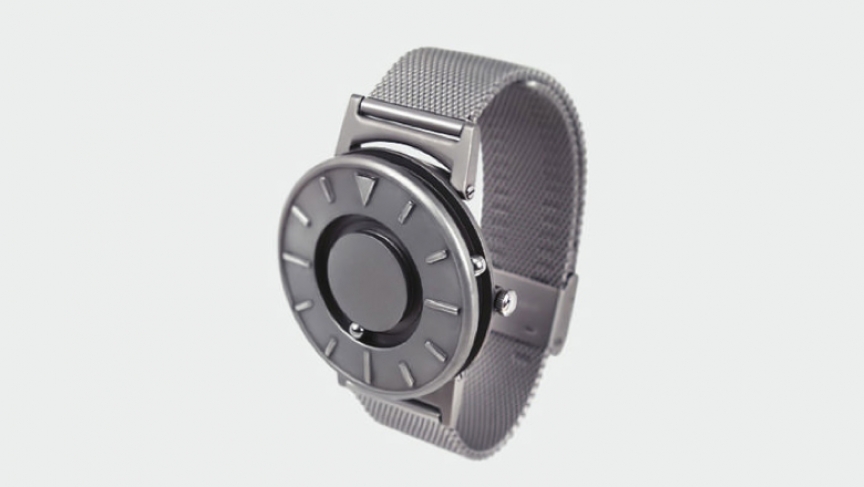
The Bradley Timepiece: Tell Time By Touch

Bradley Timepiece Tell time without sight or sound
Bradley Timepiece: With this timepiece, you don’ need sight to tell time. Credit: Eone Time

Watches designed for visually impaired people often look like any other watch. But they usually have a button on them that tells the time out loud.  The voice also sounds like a robot.   And, some blind people dislike talking watches because it draws attention to them.

To solve this attention-getting problem, the  company Eone Time  has designed a timepiece to help people avoid the attention and just tell the time.

Called the Bradley Timepiece,  it uses magnets, and two moving ball bearings, to allow people to tell time by touch. The innovative design is winning praise for its lack of sound and its different appearance.

The timepiece is named after retired US Navy Lt. Bradley Snyder. While serving in Afghanistan in 2011, he lost his sight in an IED explosion.


National Institute on Deafness and Other Communication Disorders

Struggling with what type of listening device to purchase to best help a student with a hearing impairment?  Check out the National Institute on Deafness and Other Communication Disorders (NIDCD), which is part of the National Institutes of Health (NIH).  NIDCD conducts and supports research in the normal and disordered processes of hearing, balance, taste, smell, voice, speech, and language.

A handy information resource at the NICDC site is the Assistive Devices for People with Hearing, Voice, Speech, or Language Disorders page which answers these questions and more.

  • What are assistive devices?
  • What types of assistive devices are available?
  • What types of assistive listening devices are available?
  • What types of augmentative and alternative communication devices are available for communicating face-to-face?
  • What augmentative and alternative communication devices are available for communicating by telephone?
  • What types of alerting devices are available?
  • What research is being conducted on assistive technology?
  • Where can I get more information?

Walgreens Launches Nationwide Program Offering Talking Prescription Devices for Customers with Visual Impairments

Walgreens is now  providing talking prescription labels at all of its 8,000+ retail pharmacies in the United States and through mail order. The talking prescription labels are free of charge to pharmacy customers who are blind or visually impaired.  The device also includes a timer.

The Walgreens press release is here:  Walgreens Launches Nationwide Program Offering Talking Prescription Devices for Customers with Visual Impairments