
College Tips for Students with Learning Disabilities Synopsis

Writing for Disabled-World, author Joan Azarva offers a number of useful tips and information for persons with learning disabilities attending college.

High school students who transition to college find themselves facing a whole new set of challenges. Unfamiliar with the college system, they are prone to making poor judgments. Because college proceeds so rapidly (a typical semester is fifteen weeks), a few poor decisions can produce dire consequences. This list should help students make decisions that bode for success. . . . College Tips for Students with Learning Disabilities


The mission of Disabled World is to report daily health and disability news and inform the public. disabled-world.com does not provide medical advice, diagnosis or treatment.

The information comes from in house writers, press releases, educational institutes and worldwide government organizations that submit news items, public notices and coming events for publishing. Unless noted otherwise, contributors should not be considered as health professionals, although they might have an extensive experience in certain areas.
LD Resources Foundation Awards Assistive Devices to College Students in Need

Getting the right assistive technology at the post-secondary level can be difficult for students with learning disabilities.

It’s especially tough for adults applying to college with disability documentation (e.g. test scores) that no longer satisfy the school’s requirements for granting aid. Obtaining the  necessary tests can be time-consuming and costly.

The LD Resources Foundation can help students get the assistive technology they need, regardless of where they are in the evaluation process.

The nonprofit assists young adults with learning disabilities, including dyslexia and Attention Deficit Hyperactivity Disorder (ADHD), to access and succeed in higher education so they can reach their full potential. The Foundation currently offers five awards. Persons may apply for one or more awards using a single application.

To learn more, visit Apply for LDRF Awards.

About LD Resources Foundation

LD Resources Foundation helps students and adults diagnosed with dyslexia, ADHD, and other learning disabilities to access and succeed in post-secondary education programs and the workplace. Its services, which are limited to individual with financial need, include testing, mentoring, access to assistive technology, and an awards program.  Includes resources on assistive technology, organizational skills, scholarships and a Survival Guide for adults with LD or attention deficit disorder (ADD). The foundation’s headquarters are in New York City.For more information call 646-701-0000 or email info@ldrfa.org.


8 Simple Ways Parents Can Teach Kids to Get Organized

Children and teens with ADHD and other learning difficulties typically have trouble with organization, time management, and transitioning to living independently. They need specific training on how to manage those skills, which are crucial for college and beyond.

But, to varying degrees, nearly all young people have trouble with these issues says Elizabeth C. Hamblet, a consultant and  learning specialist at Columbia University, where she helps students with time management, organization, reading, and study skills.

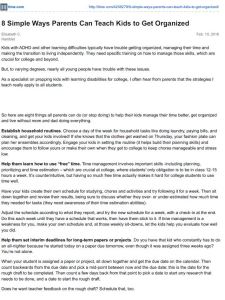
Hamlet recently authored a piece, 8 Simple Ways Parents Can Teach Kids to Get Organized, for Time Magazine, that offers eight tips all parents can do (or stop doing) to help their kids manage their time better, get organized and live without mom and dad doing everything.  This article and other helpful pieces can also be found at Hamblet’s site, Families and Students Preparation for College.

Readers may also click on the image below to access a PDF   copy of the article.


HAMBLET8SimpleWays