Fact Sheets: “What is ADD/HD?” and “Elements of Focus”

ADD and ADHD

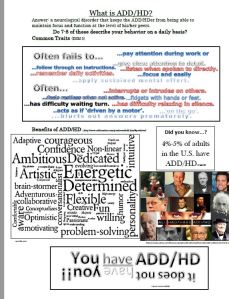
If you have ADD or ADHD, or suspect you do, check out “What is ADD/HD?” which briefly describes what ADD and ADHD are, describes strengths and offers strategies to be more effective in the classroom and while studying. There is even a quick self-assessment included.

Elements of Focus

If you have ADA or ADHD, staying focused can sometimes also be a challenge.  “Elements of Focus” offers easy to use suggestions to help students stay focused.

(Click on each graphic to open the PDF’s.)Info sheet on elements of focus


ADD/ADHD Tip sheet


Both documents courtesy Mark White, Southwestern Assemblies of God University, Waxahachie, TX


Off to College with Diabetes

Moving from home to college can be tough on students with diabetes, as well as their  families. It’s important for everyone involved in this transition – health care providers, parents, and students – to prepare, and to make sure that everyone is on the same page.  the College Diabetes Network (CDN) has created multiple resources for all of these individuals to help ease this transition.

The CDN was created out of a need young adults have experienced for years, and we have become a hub of resources, support, and understanding for this under-served population.

College students have a responsibility to create a plan for themselves that keeps them safe – just like any other adult with diabetes does. The College Diabetes Network does a great job of assisting students with that transition. Register for Accommodations

The site has a wealth of  information including information on how to manage eating in a dining hall,  There are also resources for  parents and others in the student’s support network.

If you are a college student with diabetes or are a parent, medical professional or a college disability services provider, working with a college student with diabetes, it’s worth the time to explore the CDN site.

Color Vision Deficency (Color Blindness)- Learn all about it

Color vision deficiency is the inability to distinguish certain shades of color. The term “color blindness” is also used to describe this visual condition, but very few people are completely color blind.

 Most people with color vision deficiency can see colors, but they have difficulty differentiating between the following colors:

  • particular shades of reds and greens (most common)
  • blues and yellows (less common)

People who are totally color blind, a condition called achromatopsia, can only see things as black and white or in shades of gray.

Color vision deficiency can range from mild to severe, depending on the cause. It affects both eyes if it is inherited and usually just one if it is caused by injury or illness.

Frequently individuals with color vision deficiency aren’t aware of differences among colors that are obvious to the rest of us because they have always seen the way they do and have no other frame of reference.  Consequently, people who don’t have the more severe types of color blindness may not even be aware of their condition unless they’re tested in a clinic or laboratory.

Who gets color blindness?

As many as 8 percent of men and 0.5 percent of women with Northern European ancestry have the common form of red-green color blindness. Men are much more likely to be colorblind than women because the genes responsible for the most common, inherited color blindness are on the X chromosome.

To learn more about color blindness, visit Color Blindness  At this site, you can learn more about causes of color blindness, the types of color blindness,  myths about it. the prevalence  of color blindness, types of screening tests, and much more.

An FAQ about color blindness is available at Colblindor