Ava: App That Helps Deaf & Hard Of Hearing People Follow Group Conversations

For deaf people, participating in a group conversation, where there’s constant chatter going on among multiple people, can sometimes be painful. Reading lips, trying to hear with a lot of background noise, and keeping track of who is saying what can get tricky, and in many cases, deaf people may either give up on the conversation or just pretend that they are listening.

Ava, an app for deaf and hard of hearing people, makes it easier for them to follow group conversations and keep track of who is saying what without worrying about reading lips or excessive background noise.

The app was released in 2016, and is available for iOS and Android and can be downloaded at  ava.me.

The Assistive Technology Blog has a review of the app, as does TechCrunch.
 

Using Hearing Assistive Devices at Home

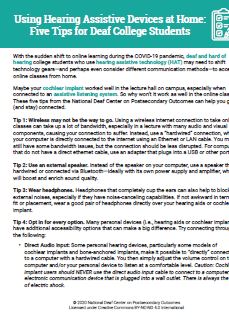
With the sudden shift to online learning during the COVID-19 pandemic, deaf and hard of hearing college students who use hearing assistive technology (HAT) may need to shift technology gears—and perhaps even consider different communication methods—to access online classes from home.

The tip sheet below from the National Deaf Center offers five tips for using hearing assistive  devices at home.


Tips for Deaf Students

Online Learning Tips for Deaf Students

COVID-19 has made colleges and universities around the United States switch to online learning for everyone — including deaf students.


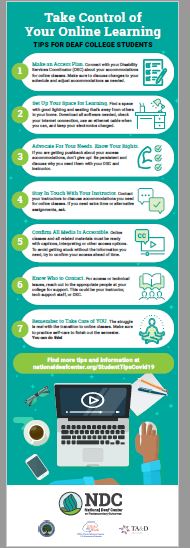
Whether you have taken an online class before or are new to this, remember: accommodations don’t stop because you are now learning remotely.  The infographic below offers strategies that can help you take control of your online learning.

tips for online learning infographic