
Teen Vogue seems like an unlikely source to find practical advice for requesting reasonable accommodations and academic adjustments in high school or college but How to Get Disability Accommodations at School, is just that, a useful, straight-forward guide for high school students preparing for college and students already in college.
Category: Advocacy
Navigating College: A Handbook on Self-Advocacy – Written for Autistic Students from Autistic Adults
The non-profit organization, Autistic Self Advocacy Network (ASAN) seeks to advance the principles of the disability rights movement with regard to autism. As part of ASAN’s work to empower Autistic people across the world to take control of their lives ASAN has available in their resource library, a handbook for college students. Navigating College.
Written by autistic adults for college students with autism, this handbook contains five topical chapters: Accommodations, Housing, Health and Safety, Advocacy, and Social Issues.
Each chapter contains several essays covering some aspect of the topic. There are 17 essays total. The introduction is written by Ari Ne’eman, president of ASAN. The introduction, written by Jim Sinclair provides an overview of the ADA.
Samantha April Davis in a brief two-paragraph piece preceding the essays reminds has this reminder for students.
You’re a college student now. Things are different fromwhat you are used to. A lot is being asked of you and it’snot always easy meeting expectations. Nobody said itwas going to be easy. You might have a bit of troublealong the way. You might struggle. A lot of peoplestruggle. You might have to ask for help. You might haveto ask even when you feel that you shouldn’t have to.You’re in college now. Remember one thing: You made itto college because you have potential. You are in collegebecause you demonstrated capability to get here. If youare struggling now, it is because you are able and, whileyour needs may be different or beyond that of thetypical college student, you are capable of meetingthose challenges given proper support.
This is a good reminder for all students.
Patient No More: the Section 504 Sit-In
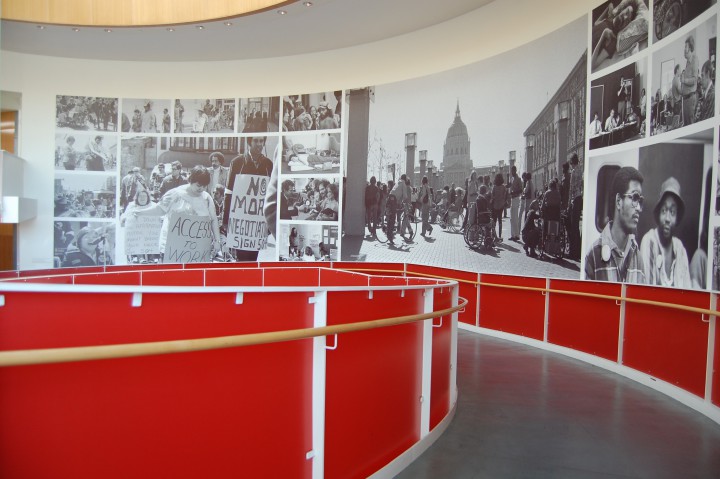
On April 5, 1977, American people with and without disabilities showed the world the power of grassroots activism. In San Francisco, more than 100 people began a twenty-six day occupation of the Federal Building to insist on getting civil rights. Four years earlier, Section 504 of the Rehabilitation Act of 1973 made it illegal for any federally funded facilities or programs to discriminate against disabled people. One signature from the head of Health Education and Welfare (HEW) stood in the way of the law taking effect. People waited and waited. At last in 1977 frustration turned into bold action. A diverse coalition launched protests across the country. San Francisco’s occupation was the most significant. On April 30, 1977, San Francisco’s Section 504 occupiers emerged victorious from the longest take-over of a federal building in US history. A national disability rights movement was born.
San Francisco’s occupation of the HEW Building at 50 United Nations Plaza became the focal point of the protest. Enduring hardships, deprivations and medical risks, the occupiers dug in, finally emerging to join an April 30, 1977, victory rally after Secretary Califano signed the 504 regulations unchanged.
A virtual exhibit exploring this historical milestone in disability history is available at:
Patient No More Virtual Exhibit

 WINAHEAD