Generation Patient

Disabled students continue to live out the mantra, “Nothing About Us, Without Us,” being out and proud on social media, creating start-ups and founding organizations around the world.

Generation Patient is one such student-to-student resource that is gaining traction. Founded by Sneha Davis who graduated with a degree in Journalism from Indiana University in 2020, Generation Patient seeks to connect students to resources, inform professionals and advocate for increased awareness and understanding of chronic illnesses as disabilities. A particular focus is on addressing ableism in the health services fields.

The team, mostly graduate students and recent graduates in professions, host virtual meetings on topics such as transitioning to college, family dynamics, advocating for fair insurance rates and prescription drugs, along with peer support.

A recent Round Table event focused on accessing higher education, with spotlights on working with campus disability services offices; being “believed” as a disabled person; and establishing trust with faculty.

Visit Generation Patient to learn more about chronic illness as a disability.
Tips from Students for More Effective Remote Learning

The National Deaf Center has collected a number of tips for being more effective learning remotely. These tips are those that students themselves have found helpful. The tips below can benefit any student.

  • Join an online deaf support group. There are several on Facebook!
  • Start a group with friends and/or classmates to motivate and support each other with being accountable to finish the term strong.
  • Manage your time well. Make sure your schedule has time for YOU, such as meditation, yoga, reading books, and exercise.
  • Use a Fitbit or similar device to remind you to get up and move.
  • Use blue light blocking glasses to help decrease eye strain. Be sure to schedule time away from electronics to decompress.
  • Set small, attainable goals and celebrate when you complete each one.
  • Make sure you get the sleep and nutrition you need.

For students who are D/HOH, in addition to the tips above, the NDC collection of tips includes specific tips on how to manage accommodations and communicating with instructors and the disability services office. To  review those tips, visit https://www.nationaldeafcenter.org/covid19faqs.

An overarching theme of all the tips is that students will fare better if they make sure they communicate  with instructors, and others to make sure they have the information they need about course expectations, assignments and other elements of the course

Covid-19 – An Open Letter to Parents

Elsewhere, at this  site, at the Parent Resources page, is the original letter, written by Jane Jarrow, a professional who has worked with students with disabilities at the college level for more than 30 years. Jarrow wrote this letter  as a parent – to other parents, as someone who shared all their anxieties about their child with a disability going off to college.

Jarrow recently reviewed the letter to determine if it still had relevance in this time of Covid-19. Everything in the letter remains true and useful, but it benefited from the addition of some information appropriate to this pandemic period. Just as disability service providers are facing a steep learning curve in doing what needs to be done to support students during the COVID-19 crisis, parents will face new challenges, as well.


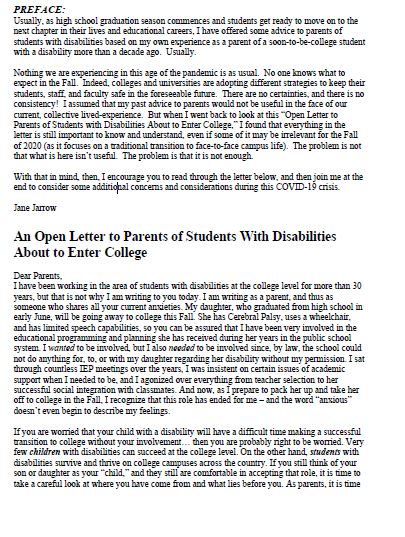
Below is the COVID-19 version of that “Open Letter to Parents.”  To access the full letter, click on the image below.


Letter to Parents of SWD